On February 21, 2026, Singapore-based Bitcoin mining company Bitdeer (also known as Bitdeer) released an unconventional weekly report on its official social media channels. The data revealed that as of February 20, 2026, Bitdeer's self-held Bitcoin balance (excluding customer deposits) had dropped to zero. During the reporting period, the company produced 189.8 BTC and sold all of them, while also net reducing its holdings by a substantial 943.1 BTC, completely emptying its Bitcoin reserves.
This "all-out" liquidation sent shockwaves through the cryptocurrency mining industry. Particularly noteworthy is the timing of this move: according to the latest data, Bitdeer's proprietary hash rate had just reached 63.2 EH/s, officially surpassing the 60.4 EH/s of the established giant Marathon Digital, making it the world's largest publicly traded self-mining company by hash rate.
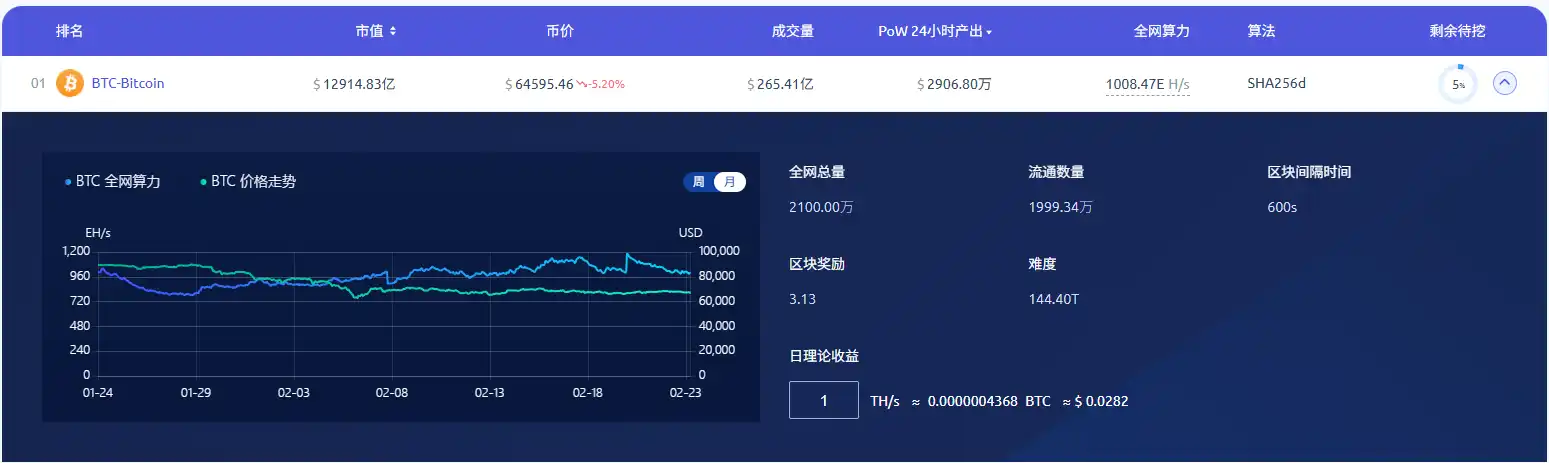
Possessing the world's highest hash rate yet choosing not to hold a single Bitcoin. This seemingly paradoxical strategic choice not only declares the demise of the traditional mining industry's "mining is hoarding" (HODL) belief but also reflects that under the extreme pressure of hash rate economics, leading mining companies are accelerating their transformation towards Wall Street-standard corporate financial operations and AI computing infrastructure provision.
Bitdeer's decision to empty its Bitcoin reserves is not due to a bearish outlook on the market but is compelled by the severely deteriorating fundamentals of the current mining industry. To understand the inevitability of this move, one must examine the underlying data of the current Bitcoin network.
According to recent data, the Bitcoin network difficulty surged from 125.86T to 144.39T on February 19, representing a 14.72% increase. This is the largest single upward adjustment since May 2021. This difficulty adjustment directly erased all the operational breathing room miners had gained earlier in the year. The sharp increase in network difficulty means mining companies need to invest more hash rate and power costs to maintain their original output share.
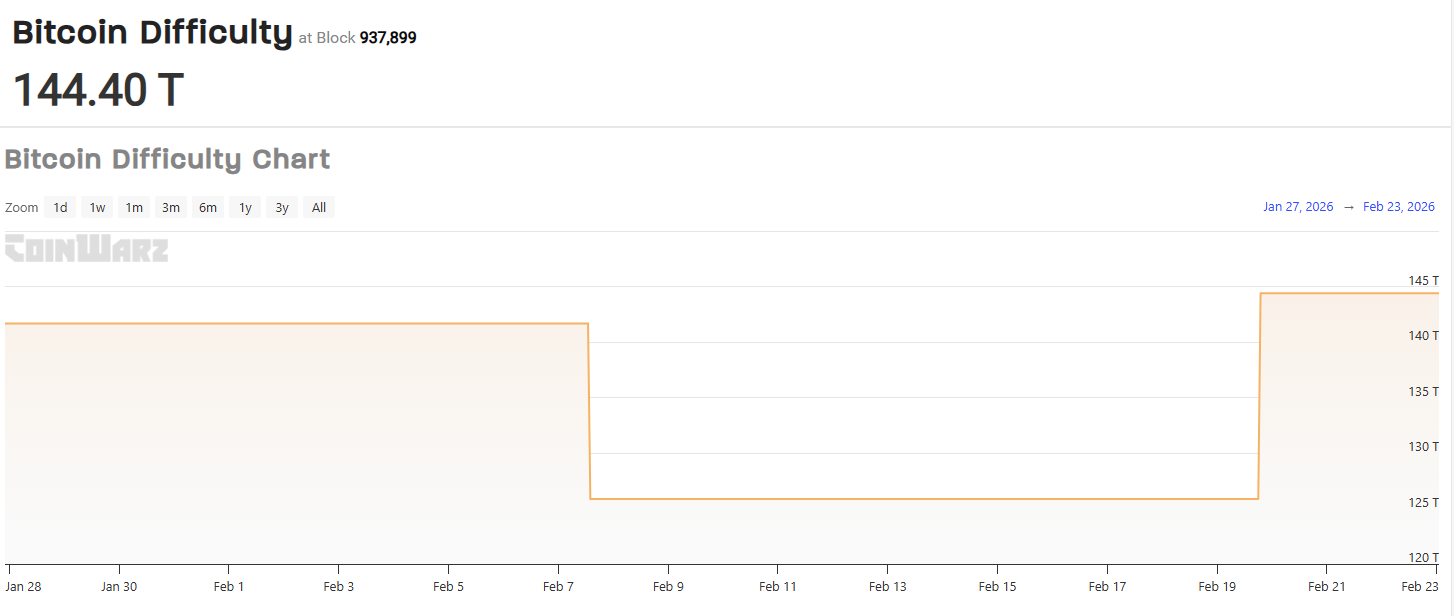
Even more致命的是 the collapse of the Hashprice. Hashprice is the most core quantitative indicator measuring miner profitability, representing the expected fiat revenue generated per unit of hash rate (typically 1 PH/s) in one day. Caught between the dual pressures of soaring network difficulty and Bitcoin price volatility, the global Hashprice has plummeted to less than $30/PH/s/day. This figure is approaching historical lows.
With the Hashprice falling below the $30 mark, the vast majority of miners using older models or with electricity costs higher than $0.06/kWh are already on the brink of shutdown price, or even in a state of negative gross profit. For a giant like Bitdeer, although it benefits from economies of scale and certain energy cost advantages, the severely compressed profit margin makes it impossible to continue bearing the risk of anchoring assets to a single, highly volatile cryptocurrency.
In today's environment of high capital costs, holding Bitcoin represents a decision with huge implicit opportunity costs for mining companies. Every BTC hoarded means less cash flow available for expanding reproduction, upgrading equipment, or repaying debt. In a cycle of极度 compressed profit margins, "cash is king" has replaced "HODL is king." Liquidating holdings is the most direct defensive move against liquidity constraints.
Wall Street Financial Engineering: Convertible Bonds and Defensive Debt Restructuring
Facing the decline in hash rate returns, Bitdeer's solution is not limited to selling Bitcoin. Its actions in the capital market demonstrate highly sophisticated financial engineering capabilities. On February 20, Bitdeer announced an increase in the size of its private placement of Convertible Senior Notes to $325 million. The transaction is expected to settle on February 24, and the initial purchasers also have an option to buy an additional $50 million in notes.
This financing of up to $375 million is meticulously designed in its use of funds, representing a textbook example of defensive balance sheet restructuring:
Debt Extension and Replacement ($138.2 million): Bitdeer will use $138.2 million to repurchase its existing 5.25% Convertible Senior Notes due in 2029. This "refinancing" operation, in the current complex interest rate environment, essentially aims to optimize the capital structure, extend the debt duration, and secure a longer cash flow runway for the company's future strategic transformation. During a period of low Hashprice, reducing short-term debt repayment pressure is core to maintaining corporate survival.
Capped Call Transactions ($29.2 million): Bitdeer allocated $29.2 million for Capped Call Transactions. This is a highly specialized derivative hedging strategy. Convertible bonds, because they include a conversion option, can lead to significant dilution of existing shareholders' equity if the bondholders exercise their options when Bitdeer's stock price rises substantially in the future.
The Capped Call acts as a form of "anti-dilution insurance." By purchasing a combination of call options, the company can offset the dilutive effect of bond conversion through option gains when the stock price rises within a specific range. This sends a clear signal to the market: management is confident in the company's long-term market value and is极力 protecting the interests of existing shareholders.
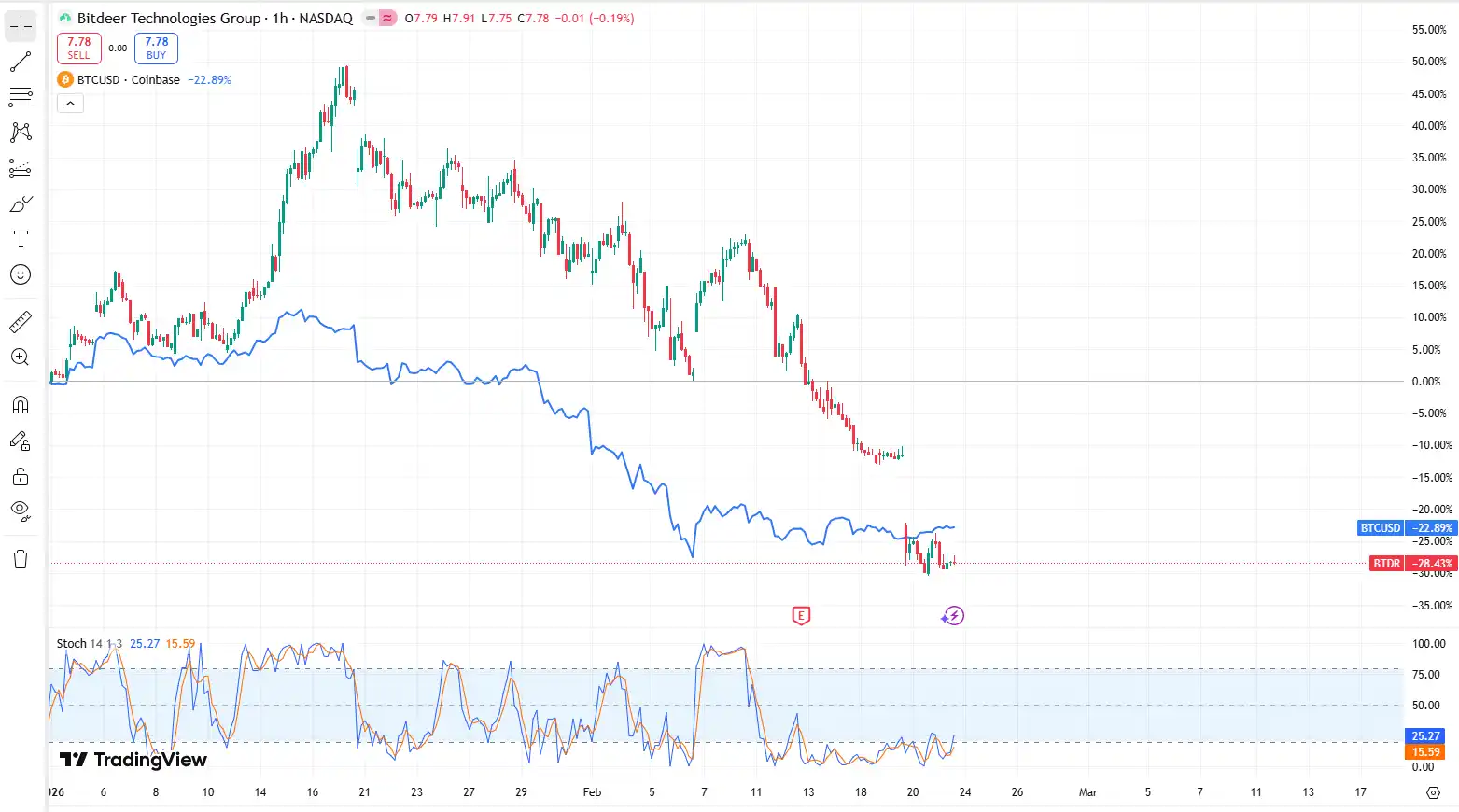
This complex combination of moves indicates that Bitdeer's financial strategy has moved beyond the early rough-and-tumble stage of the crypto industry and entered a period of refined capital operation on par with top-tier tech companies on Nasdaq.
After deducting the costs of debt restructuring and option hedging, the remaining hundreds of millions of dollars in raised capital, plus the cash obtained from liquidating Bitcoin, reveal Bitdeer's true ambition: to shed the label of a "pure Bitcoin miner" and fully enter the fields of High-Performance Computing (HPC) and Artificial Intelligence (AI) cloud services.
Amid the wave of generative AI explosion, the global computing power market is facing an unprecedented supply-demand imbalance. The training and inference of AI large models require massive computing power clusters, which in turn demand enormous throughput capacity for energy infrastructure (electricity and data center cooling).
Bitcoin mining companies possess a unique arbitrage advantage in this macro context. Miners are essentially energy arbitrageurs; they control some of the world's cheapest, largest-scale power resources and highly scalable data center land. Bitdeer explicitly stated that the new funds will be used for:
- Expanding the scale of HPC and AI cloud business.
- Developing proprietary ASIC mining equipment (achieving vertical integration of the hardware supply chain, reducing Capital Expenditure Capex).
- Expanding high-standard data centers.
Transforming or upgrading low-margin Bitcoin mining infrastructure into high-margin, high-stability cash flow AI data centers is currently the core transformation narrative for large mining companies. AI customers typically sign long-term, fixed-rate service contracts (like PPAs), which stand in stark contrast to the Bitcoin mining revenue model that fluctuates violently daily with the Hashprice.
By liquidating Bitcoin and issuing convertible bonds, Bitdeer is essentially investing its inefficient past (hoarding coins) into a future with higher certainty (AI infrastructure).
Bitdeer reached the global top with 63.2 EH/s of hash rate, yet simultaneously set a record of "zero coin holdings." This phenomenon marks a fundamental divergence in the business models of publicly traded mining companies worldwide.
Under this logic, having the world's largest hash rate does not mean hoarding the most coins; it means possessing the largest cash flow generator and the most massive energy load capacity. When the profit generated by this machine falls below a threshold,毫不犹豫地 investing capital into the AI sector, which offers higher returns and greater era-specific dividends, becomes the most rational choice aligned with quantitative and capital allocation principles.
In the challenging post-halving cycle of 2026, blind hoarding is no longer a universal panacea. For investors in financial markets, this is no longer a story about "mining" but will be a hardcore narrative about energy, computing power调度, and Wall Street capital efficiency.